
Meet Dylan Sara: The Watercolor Portrait Artist Who Teaches You to Truly See
When I bring a guest instructor into the Kara Bullock Art School community, it is always because something about their work stopped me in my tracks.
Dylan Sara stopped me in my tracks.
Dylan is an Australian-born illustrator and artist who now lives in Göttingen, Germany with his wife and three children. He has spent years painting and drawing portraits, teaching online and in person, painting large murals, illustrating books and magazines, and hosting live sketch sessions with artists from all over the world.
But honestly, his background is not even the part that got me. It is the way he thinks about making art.
"It's all about the people and the process of sketching and connecting to those people, and whatever format it is in, whatever scale, whatever medium, I really enjoy it."
That is not something you say for a bio. That is how Dylan actually lives his practice. And it comes through in everything he teaches.
Why His Approach Is Different
Most artists who want to learn watercolor portraiture jump straight into the paint.
Dylan starts somewhere else entirely. He starts with your eyes.
Observational drawing is the practice of truly looking at what is in front of you. Not drawing what you think a face looks like. Not relying on habit or muscle memory. Actually seeing the specific distances, angles, and shapes that belong to this particular person in front of you, and putting those down on paper.
It sounds simple. It is not. Most of us have spent years reaching for the shorthand version of a nose or an eye rather than the real one.
Dylan's method breaks that habit. And once it breaks, everything changes.
His process for each portrait moves through three phases:
Observational line drawing with colored pencil - Looking carefully at proportions, angles, and the relationships between features before a single drop of watercolor touches the paper
Watercolor - Layering in value and color, alternating between careful control and letting the water do what it wants to do
Final definition - Returning to pencil to sharpen details and bring the two media together
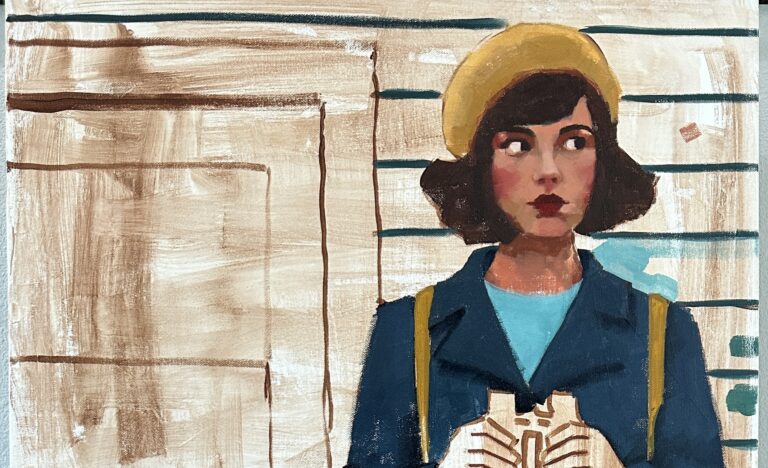
Here is the part I love most: the pencil drawing does not disappear under the paint. It stays visible in the finished piece. The linework becomes part of the portrait itself, giving it texture and life that a purely painted piece often lacks.
Learning to Let Go


One of the biggest struggles artists have with watercolor is the feeling of being out of control.
The medium is unpredictable. It blooms in unexpected directions. It dries differently than you planned. For portrait work especially, that can feel really scary.
Dylan does not try to make watercolor feel safe and controlled. He teaches you to work with it.
Throughout the course, he comes back again and again to the idea of control and looseness. There are moments for careful, deliberate layering. And there are moments to let go and let the water move. Because the observational drawing underneath has already locked in your proportions and likeness, you can afford to be freer and more playful with the paint.
"Loosen up, don't be afraid of the medium, just enjoy the process."
The goal he is working toward is something I think a lot of us want: the ability to complete a confident, expressive portrait in a single sitting. Not a labored, overworked piece. A portrait you finish in around an hour that actually looks like the person.
If you have ever spent three sessions on a portrait and still felt like something was off, you will understand why that goal matters.
What Is Inside the Course
Dylan's Observational Drawing and Watercolor Portraiture course is self-paced with lifetime access, so you can work through it on your own schedule.
Here is what you get:
- Lessons: 15 portrait tutorials, each 1 to 2 hours long
- Total content: 15+ hours
- Media: Colored pencil and watercolor throughout
- Bonus: Zine-making: how to compile and print your finished portraits
- Access: Lifetime access with downloadable content
Each tutorial walks you through a complete portrait from start to finish. As the course goes on, Dylan's observational breakdown becomes more fluid and less spelled out, because by that point it has started to become part of how you work.
I also love the Zine bonus. Dylan has a genuine love for making zines, and he walks you through how to take your finished portraits from a PDF all the way to a printed, shareable booklet. It is such a satisfying way to hold what you have made.
Is This Course for You?
Dylan's approach works for artists at any level. But it is especially worth your time if any of these sound familiar:
- Your portraits feel a little off and you cannot quite figure out why• You have tried watercolor and felt overwhelmed by how unpredictable it is
- You want to build a regular portrait practice but do not have hours to give to each piece
- You draw from habit and want to actually train yourself to see what is in front of you
- You feel comfortable with pencil but have not found a satisfying way to bring watercolor in
You do not need to be an advanced artist. The observational method is something you build through practice, and the course is designed to build it portrait by portrait.
I am so glad to have Dylan's course here. If you have been wanting to push your portrait work further, or finally make watercolor feel like something you can actually work with, I think you are going to love this.

Frequently Asked Questions
What is observational drawing in watercolor portraiture?
Observational drawing means truly looking at your subject, measuring shapes, angles, and distances, and drawing what you actually see rather than relying on memory or habit. In watercolor portraiture, it builds the structural foundation that lets you paint more freely and expressively.
Who is Dylan Sara?
Dylan Sara is an Australian-born illustrator and artist based in Göttingen, Germany. He teaches observational drawing and watercolor portraiture online and in person, and has spent years painting murals, illustrating books and magazines, and hosting live sketch sessions with artists worldwide.
What does Dylan Sara's watercolor portraiture course include?
The course includes 15 portrait tutorials of 1 to 2 hours each, totaling 15+ hours of content. It covers observational line drawing with colored pencil, watercolor painting, and a bonus zine-making module. Students get lifetime access with downloadable content.
Do I need to be an experienced artist to take this course?
No. Dylan's observational method is built through practice, and the course develops that practice portrait by portrait. It is designed for artists at any level who want to improve their watercolor portraits.
How long does it take to complete a portrait using Dylan's method?
Dylan's goal is to help students create confident, expressive portraits in around an hour. His three-phase method is designed for single-sitting portraits that do not require a large time investment.